Categories
Professional Development

My Mentor

I spent the first 31 years of my life in Romania where schools are intense and sixth grade geometry problems are worthy of the Fundamentals of Engineering exam. While the education I received was very good and I still remember my teachers I cannot remember having a mentor. Now I know that even without a formal mentor there were many people, events, books, music and movies that influenced my life like true mentors.

Music was my first mentor.

In Romania, during my childhood, the music stores were well stocked with Romanian classics, modern and folkloric music, and the classic music by the giant composers Beethoven, Mozart, Tchaikovsky, Prokofiev and many more. The modern music of the West was conspicuously missing from the front shelves because it was sold through the back doors to people other than people like me. So I bought the discs that were on the shelves.

The great classics!

I could only afford to buy one vinyl record at a time and by the time I would get another one I would have the first one memorized.

I don’t know if the tumultuous history of Romania or the harsh history of some neighboring countries had an influence on me but my favorite composer was and is Beethoven. The drama in his music resonated deeply with me and his music may have been my childhood first mentor. I learned from him that beauty is in everything. I learned discipline from the well organized concertos and symphonies. I learned how to hear the stories in his music. Then the music connected me with math. I would listen to music while doing my homework and it felt that the problems were much easier. I started to love math homework and I still do.

I have been listening to the great classics and thought this was the best music until one day my friend shared some of her discs with me. All western modern music. The first album was Tatoo You by none other than the Rolling Stones. Wow! I did not speak english and did not understand the words but I memorized the music and the lyrics. All the albums in her collection were not like mine, you see those were on the back shelves at the store where only certain people had access. My point, you may ask, is that there is always more that we can see or find. Sometimes those things comes to us but sometimes we need to reach out and find them.

All of my mentors, people, music or nature, have come to me and left unforgettable marks on my life. Others were out there for me to reach out. I learned that when need strikes it is great to remember to reach out to my mentors.

For Margaret.

Categories
Professional Development

How I studied for and passed the PMP test (it was not effortless)

The Project Management Institute (PMI) is a leading international organization for project management career and professional development. But you know that already and the purpose of my post is to share some of the things that helped me and might help you to pass the test and become certified.

I started the process by becoming a PMI member and went through the prerequisite training. The PMI membership came with the books required to study and discounts for other helpful reading materials. I took the test almost one year later. And that was OK.

I jumped on YouTube and watched one video that promised I can pass the exam without studying (I wanted to believe it) only to hear the author saying that it took 4 weeks to read the PMBOK and one more to read the Agile Manifesto. So yes, it does take quite some time to study for the exam. I watched another two videos. Their advice was to read the books; now; and solve practice tests; now; then read about the knowledge areas I was weak in; solve another practice test; take the real test.

This worked.

I registered for the test on a date five weeks from that day and mapped the PMBOK 6, PMBOK 7 and the Agile Manifesto in four weeks worth of time. I saved the last week for practice tests and rest before the test. Then studied.

On the test day I went to the test site (there is an online version but I knew how much better I could focus in a small cube with no distractions or options to move around) and waited for two hours for the system to start functioning and for the test to start. Almost five hours later I finished and the result was Pass! Yay! Now what? No more problems to solve? After a marathon of situational questions that had my mind in high gear and my heart pacing itself to make it through? Just drive home and continue working as if nothing happened? Well, yes. A little bragging or sharing the news with family, friends and coworkers helped transition down from high gear.

So how did I actually do it? Was it hard? Yes and no. Yes because it took a long time from when I became a PMI member and started the training until I took and passed the test. I could have done it faster but I let other commitments take precedence and postponed the test taking. No because the material I studied is very good and I am applying it every day not only in work situations but in my private life as well.

What happened first?

A coworker who had taken the test a few months before offered advice.

1. Become a PMI member and save money overall – I did it without hesitation, very good idea.

2. He recommended Udemy, a website that offers the 35-hour prerequisite training program at a lower price than offered by other providers. The website clarifies whether or not the training is accepted by PMI – I checked that before enrolling and it was OK. Always check before committing.

3. He recommended that I study every day as many hours as I can between scheduling the test and the day of the test. This was to be a five-week period for me.

4. He said that by the middle of my training time I should be able to fill out the Knowledge Areas table without consulting the book and know the inputs and outputs for all the processes.

What was next?

Udemy! YouTube! Audible! Scribd!

All three platforms have very good information and using the audio resources was helpful because I drive quite a few hours every week and I catch as much as I can while driving.

The three channels I followed and found very helpful are:

  • PMPwithRay – Ray’s videos are very well done and he also offers a set of practice tests. I purchased his set for less than $50 and took the tests at least three times at 1-3 weeks intervals. The best part about the tests is that Ray offers full explanations for each answer and provides links to the respective videos on his YouTube channel.
  • David Mclachlan’s 200Agile PMP Questions and Answers. David goes through each question and answer methodically and explains why an answer is good or bad. He helped me develop a test taking mind set while also cementing my understanding of the Agile methodology. I think I went through the first 150 questions and it was fine.
  • Varun Anand’s YouTube videos and his eduhubspot platform have a wealth of very good videos. He updates his content to keep up with the PMI changes to the test materials. Varun posted a video with his tips for passing the test and I recommend it, as well as the one providing tips on the logistics of the test: taking the breaks and more.

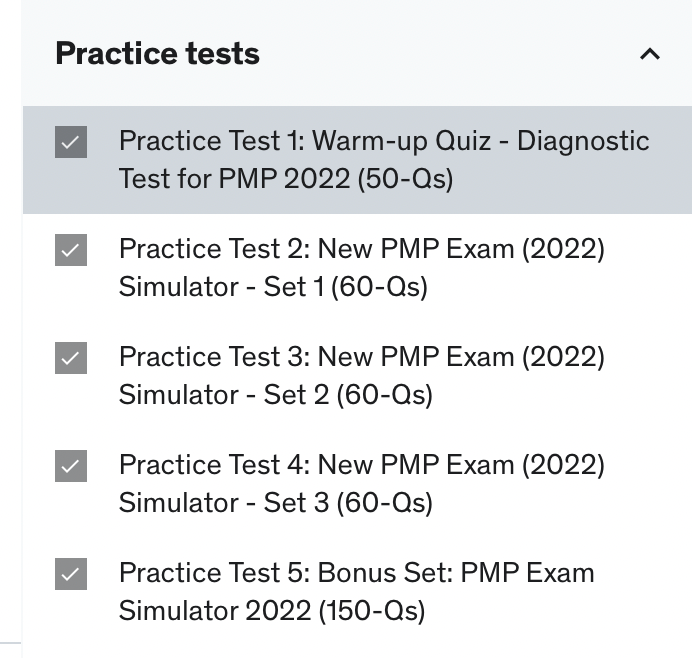
Watching videos and listening to audio books was then supplemented by reading the manuals and linking the material read with the questions. This was the most helpful part of the study program. Mixing up the video, audio, and hard copy materials with taking sample exams every week. The bundle of exam included five tests and by the time I retook each I hardly remembered the questions.

Ray’s practice test bundle on Udemy

I passed, now what?

The certificate was generated 2 weeks after I took the test and that is when I also received the analysis of my scores. I had above target scores for al three domains: processes, people and business. It felt good to see the results of my studying pay off.

I wish you the best of luck with learning the materials and passing the test. I hope you will do great!

Categories
Professional Development

Changing my Career Path

My friend Roberto took a few profesional head shots, then I put this hat on and this is the result. Lots of good expression lines, if I may say so.

There is nothing like being comfortable on a career path I selected for a long term, and then deciding that time for a change is now.

A few months ago I reached the conclusion that the best next step for me is to make a career change. I thought it will be an uphill and long search and I was not far from the truth; however, I flattened the slope after a couple of steep bursts.

At first I made a dream board with things I dreamed of doing and furiously looked for openings that matched those dreams. Teaching was one, being a public servant was another one and opening a business of my own was yet another before the idea or retirement stopped me dead on my tracks.

Retirement.

I needed to take that in one more time. What does it mean? What will I be doing with my time? But most importantly, will I be able to afford it?

I did not linger for long on that thought. It was too blurry and unappealing. Instead I continued looking for the available openings and writing more ideas on the dream board. I was doing all this in a void, all by myself, other than my husbands’ and daughters’ advice. That did not work nor did it feel right. I applied to several positions and I did not hear back from more than one: rejection.

Then I understood that I need to reach out for help. I opened the “box” of friends and colleagues from previous jobs and started conversations. It was the best idea – and you are probably thinking “duh”, but when you are in the middle of it you may not think of it at first. I didn’t.

Yes! And I received help! Starting with reviewing and drastically updating my resume and continuing with a series of why, when, who, and what are your dreams. It was the best push and it was in the right direction. I went through four or five versions of the resume, a couple of mock interviews and a few sessions of recording myself answering various questions that an interviewer might ask. I even reached out to one of my engineer friends who is a photographer and who took a few headshots for my new resume. They are amazing! I like the woman I see in those pictures.

The next help was the almighty Internet (did you know that one of the most beautiful women in the world came up with the idea that the internet is based on but never, or almost never received credit for it – Hedy Lamar?). I found “WorkitDaily” and other sites (a google search away) that gave me not only tips on how to present myself correctly and thoroughly but also improved my opinion about myself. The simple act of answering those questions made me think about all my strengths, qualities, skills and accomplishments. I am sure that so many of us take ourselves for granted and forget so many of the things we did to be who and where we are today.

Lastly, I started calling and emailing my friends.

The End.

P.S. I found my dream job and I am sure you can find yours if you are looking and even if you are not; if you find yourself in a comfort zone, start asking yourself questions and start updating your resume – it will open new horizons for you!

Categories
Professional Development

Public speaking and my story of Las Vegas

A few years ago I joined a Toastmaster club at the recommendation of a coworker friend and I remained active for several years.

Preparing for a speech was work at first but it gradually became fun. It was like solving a puzzle where the right pieces needed to be in the right places. Some speeches took days to write and I find that those were the ones when the subject was either too ambitious or not quite ambitious enough.

One speech that I thought was perfect was about my first visit to Las Vegas. The city that never sleeps and is renowned world wide for the adult playground it provides. That is what people usually think about Vegas. But the perspective I spoke about was different: the city as a transportation hub and as a man-made wonder surrounded by nature-made wonders.

I took the stage and I began my story when I landed at the empty airport, one hour after midnight. I was nervous about spending hours to figure out how to get to the hotel and not being able to rest for the next day. There was no need for my worry though because the app I used to call an Uber showed me the exact path I was to follow to meet my driver. Yes, it was an intricate and long walk but I had no trouble finding my way. That option was never before available on my Uber app. The driver dropped me off in front of the main doors of my three-tower hotel, at the designated taxi spot. I learned during my stay that the hotel had designated spots for each mode of transportation and those were marked on the hotel map and directional signs were ubiquitous. Despite the size of the hotel, the traffic flow was flawless.

The Strip, where the sidewalks seemed to be twenty feet wide, gave ample room to everyone. At well selected spots there were overpasses crossing the street that branched out for multiple accesses. It was the first time in a large city that I did not worry about crossing the street, or about running into people on the sidewalk. It was clear that those pedestrian facilities were not an afterthought but carefully planned, designed and built.

Then I spoke about the man-made wonders that extended as much underground as they did above ground and their display in the most favorable light throughout the day and night. Sure, the Eiffel tower and the canals of Venice look very artificial, but for a playground I thought they were well made.

I concluded my speech by describing the natural wonders that I visited outside the city with their grandeur and splendor. Thinking about Death Valley with hundreds of square miles of dry salt sea below the sea level still makes me hold my breath. I don’t know if the architects of Las Vegas wanted to compete with nature or enhance it by creating their own wonder, but I do know that it would have been a mistake to miss one or the other.

I spoke for 7 minutes about three aspects of the city that never sleeps: the welcoming transportation system, the playful architecture of the city and the complement of the grand natural wonders just outside its skirt. When I was done speaking I received the biggest applause (there were nine people in the room but it felt like one hundred) and sincere kudos for a very good speech.

The feedback I received pointed out that the speech was rich in simple descriptions that were delivered skillfully (if I may say so). I used three different spots on the stage area for each segment of my speech. I used arm gestures to express the grandeur of the city and of the natural wonders and I modulated my voice differently for each of the three parts. My face helped me too by expressing how passionate I was about my story.

Each time I rehearsed the speech I was not completely happy, often stopped in the middle and started over, but on the stage I presented it without a flaw. I loved the subject and I relived my visit as I was presenting it.

I am no longer a member of the Toastmaster club but I took with me the lessons I learned.

Being a good speaker starts with listening skills. By paying close attention to what is being said, asking clarifying questions and paraphrasing, you empower yourself to be a better speaker.

Non-verbal communication skills come into play next. Albert Mehrabian, a Professor Emeritus of Psychology at the University of California, Los Angeles, who was originally trained as an engineer, is best known for his publications on the relative importance of verbal and nonverbal messages and developed the 7%, 38%, 55% equation: Total Liking = (7% Verbal Liking )+ (38% Vocal Liking) + (55% Facial Liking). His theory provides important support for the fact that appearance matters in communications. His work Silent Messages was published in 1971 and has been interpreted and misinterpreted often. But his equation remains valid and cultivating voice skills and paying attention to what “face” we put forward make 93% of the tools needed to deliver a good speech.

And lastly, clarity and concision means saying enough to convey the message without saying too much. This is much harder these days since technology allows us to deliver our messages instantaneously. Centuries ago, people developed their messages during long periods of time and they were close to perfection. Now I remind myself to take a little extra time before sending a written message.

Being a good communicator and public speaker takes knowing the rules and practicing until you love what you are saying; it takes time, patience and determination, but it is well worth it. The Death Valley and the mini Eiffel tower are my witnesses!